

EDUCATION REQUIREMENTS
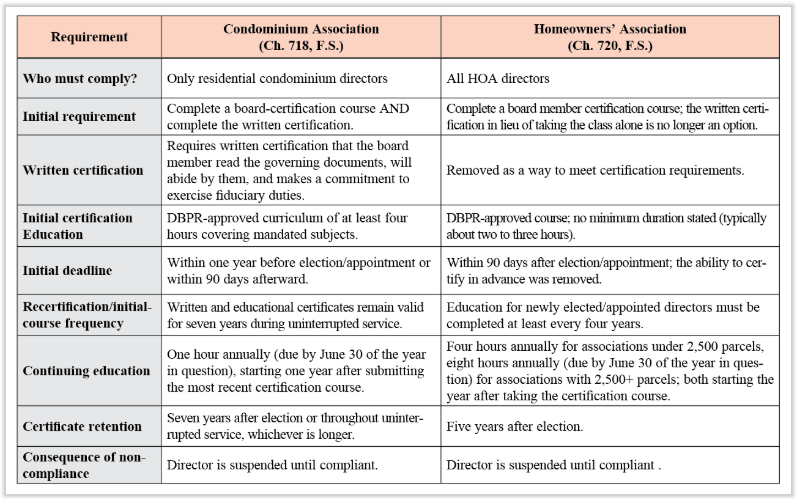
As election season will soon be at hand, it is always a good idea to review both initial certification and continuing board member education requirements. There are significant differences as related to condominium board members as compared to homeowner association board members for both the board certification class and the continuing education requirements, as you can see in the chart below.
Throughout the year Kaye Bender Rembaum P.L. offers free board member certification courses as well as continuing education courses for all attendees on a rotating schedule so that you can enjoy one or more of them from the privacy of your own home. To view the calendar, use your browser to visit KBRLegal.com.
RULES and POLICIES EVERY BOARD SHOULD CONSIDER ADOPTING
If you wait until you actually need any of the types of rules and policies discussed below, then in all likelihood you have waited too long. The purpose of adopting the rules and policies discussed below is to provide for the orderly operation of your association so that your day-to-day activities are not encumbered by one or more cantankerous association members whose sole purpose is to wreak havoc upon the board.
A. OFFICIAL RECORD REQUESTS RULES
The board should consider adopting rules regarding official record requests and where and how such requests must be sent. Absent that, a member could send an email or scribble their request on a napkin and give it to a board member triggering the statutory timeline for a response, which can lead to financial penalties for failure to timely make the requested records available for inspection and copying. Such rules can also take into account the permitted frequency of official record requests from a member as well as maximum time to perform such inspections.
Condominium associations should also consider adopting similar rules regarding written inquiries received from an owner via certified mail as failure to properly respond can lead to the association not being able to collect attorneys’ fees and costs in the event of later litigation that was the subject matter of the written inquiry received via certified mail. Such rules can also take into account that each subpart of a question counts as a separate individual question, thereby providing for a total number of questions, including all subparts, to not exceed 20 in total.
B. BOARD AND MEMBERSHIP MEETING DECORUM RULES
These rules can assist business being conducted in an orderly fashion at meetings and can include, without limitation, when the members have the right to speak, a time limit for owner statements (such as three minutes), and other important conduct provisions. Failure to follow such rules leads to the member being excused from the meeting, pending the circumstances. In addition, these rules can also provide for board member decorum as well.
C. ADOPTION OF A COLLECTIONS POLICY
Essentially, having a standardized collections policy ensures that not only are all owners treated similarly in regard to a delinquency, but also it provides for timely and standardized procedures. Such a policy can provide for such things as sending a reminder letter when an owner is a certain number of days past due (such as 15 days), followed by a continuing instruction to management to send the notice of late assessment if the debt is not paid within 30 days of the first letter. If the owner still has not satisfied their delinquency prior to the expiration of the 30 days of the notice of late assessment, then management is instructed to turn the matter over to the association’s attorney to begin collection/foreclosure proceedings, which are so authorized by the collections policy. Such a policy would also include the appropriate interest rate and late fees to be charged in accordance with the association’s governing documents.
As a reminder, the Florida legislature enacted requirements not too long ago that the association provide one final 30-day notice to a delinquent member before commencing collection and foreclosure activities. This is referred to as a notice of late assessment (NOLA). Upon request the association’s attorney can prepare detailed instructions and provide draft forms so as to ensure statutory compliance.
COLLECTION and FORECLOSURE ACTIVITIES
Your board is reviewing delinquencies and discovers that certain members are very delinquent with their payment of assessments. The manager is instructed to turn those files over to the association’s law firm to begin collection-related activities. Because the burden of proof is on the association to prove the debtor is delinquent, all supporting information regarding the delinquency should be part of the turnover file given to the attorney, which includes providing the “basis” or “backup,” if you will, to substantiate the monies due to the association. Therefore, typically the association needs to provide the following documentation to its attorney as a part of the collection turnover package to commence collection related activities:
- A copy of the debtor’s ledger that goes back to the last zero balance (in other words, the ledger showing the last time the owner was not delinquent).
- A copy of the notice of late assessment as required by Florida law (and the affidavit of mailing, if available).
- If a special assessment is included on the ledger, then a copy of the meeting notice that was posted and mailed to all of the members at least 14 days in advance, the resulting meeting minutes and the notice that was sent to the membership advising that the special assessment was adopted/passed, and the due dates.
- If a fine is included on the ledger, and the declaration permits fines to be converted into an assessment, then all of the backup paperwork must be provided, which would include the notice of board meeting where the fine was considered, a copy of the correspondence sent to the owner at least 14 days prior to the fining committee meeting, the minutes resulting from the fining committee hearing, and a copy of the correspondence sent to the owner thereafter advising them as to the debt owed. In addition, depending on the exact language in the declaration, it may be necessary for the board to actually take official action to convert the fine into an assessment (please note that a fine can only potentially be converted into an assessment for a homeowners’ association governed by Chapter 720, F.S.). It is not always automatic, even if the language might lead the ordinary reader to believe as much, and at times it is still necessary to convert the fine into an actual assessment. With that in mind, it is always a good idea to discuss whether your declaration permits the fine to automatically be treated as an assessment, or if other action is required by the board to do so. And remember, unless the declaration provides the authority for the fine to be treated as an assessment, then it cannot be collected as an assessment. Rather, the association would have to resort to other collection means such as small claims court to collect the fine.
The association’s attorney will be a tremendous resource to the board and will play an integral role with assisting the board in conforming all of the above-discussed rules and regulations and policies to your association.