
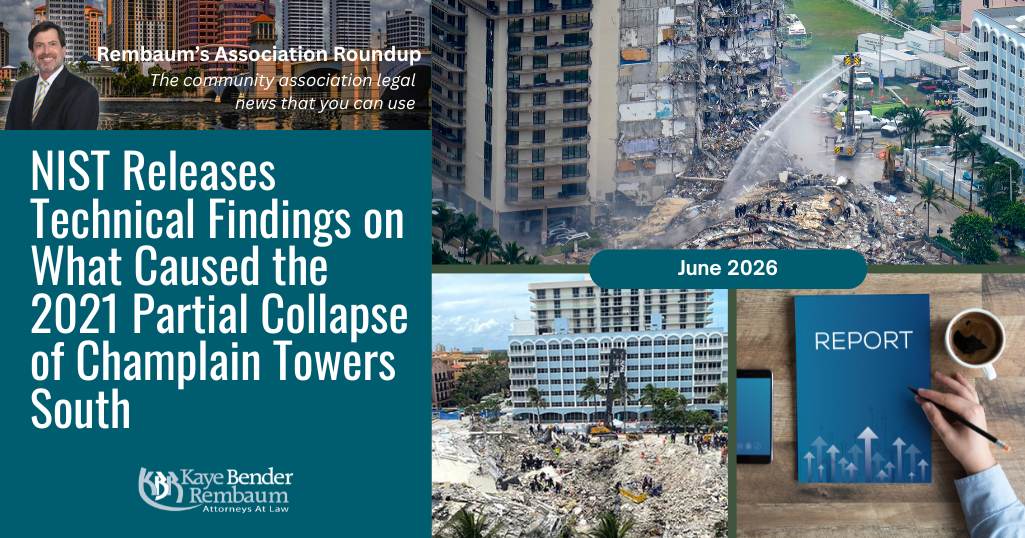
The National Institute of Standards and Technology (NIST) has released its long-awaited technical findings regarding the catastrophic collapse of Champlain Towers South in Surfside, Florida. While the tragedy has often been attributed to deferred maintenance, corrosion, and years of exposure to a harsh coastal environment, NIST’s investigation tells a more comprehensive and, in many ways, more troubling story. The report concludes that the building’s structural vulnerabilities were present from its original construction.
At the time of construction, there were significant deviations from the building codes and engineering standards in effect at the time, together with construction deviations from the design drawings, resulting in a structure that possessed unusually small margins against failure from the very beginning. In essence, the building lacked the substantial reserve strength that properly designed structures are expected to have.
According to NIST, buildings constructed in accordance with applicable codes should possess sufficient redundancy and reserve capacity to withstand loads well beyond those encountered during normal service. Champlain Towers South did not. Its load-bearing slab-to-column connections were designed and built with margins against failure that were far too narrow. Over the ensuing four decades, corrosion of reinforcing steel, deterioration of concrete, and modifications that added significant dead load to the pool deck steadily consumed what little reserve capacity existed. These factors did not independently cause the collapse. Rather, they progressively weakened a structure that was already deficient from the outset until the remaining margin of safety disappeared.
The accompanying NIST video (via the blue button below) explains how the collapse sequence actually began approximately three weeks before June 24, 2021, when critical slab-to-column connections beneath the pool deck failed. Those initial failures redistributed loads to adjacent structural elements that likewise lacked adequate capacity, setting in motion a progressive chain of failures that ultimately culminated in the catastrophic collapse of much of the tower. This report summarizes the principal findings presented in the NIST video and discusses the important lessons they hold for engineers, community association boards, property managers, and anyone responsible for the long-term stewardship of aging buildings.