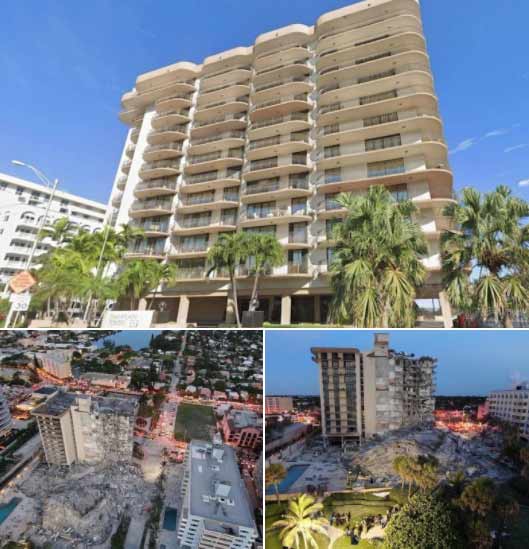
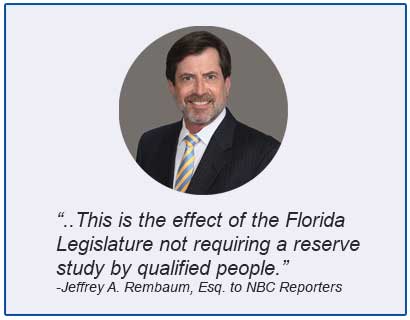
NBC NEWS Reports Condo Could Have Been Repaired Faster Under Prior Law | July 7th Building Maintenance Video Now Online


The 2021 Florida Legislature was busy indeed. This year’s new legislation brings tremendous clarifications of existing laws and new laws to Florida’s community associations. All of the bills discussed herein were approved by the Governor, and are now in effect (unless otherwise noted). To view the bills that were passed into law, please visit kbrlegal.com and click on the “2021 Legislative Update” on our homepage. A printable version of this article is available HERE.
Following are laws applicable to:
1) Senate Bill 602, effective May 7, 2021, provides additional clarification for already existing laws in Chapter 617, Fla. Stat., known as the Florida Not For Profit Corporation Act.
a) §617.0725, Fla. Stat., clarifies that amendments to the articles of incorporation and bylaws of condominium, cooperative, and homeowners associations which effect or impose a quorum or voting requirement greater than the general quorum or amendment vote requirement are not required to be approved by the greater quorum or voting requirement then in effect or proposed to be adopted when voting to lower the threshold.
b) §617.0825, Fla. Stat., adds organizing committees established under §720.405, Fla. Stat. (covenant revitalization), to the existing list of condominium, cooperative, and homeowners associations exceptions to the board committee and advisory committee requirements of §617.0825.
c) §617.1703, Fla. Stat., further clarifies existing law that in the event of conflict between the Florida Not For Profit Corporation Act and Chapter 718 (condominiums), Chapter 719 (cooperatives), Chapter 720 (homeowners associations), and Chapter 723 (mobile home parks), the provisions of those specific chapters apply over that of the Florida Not For Profit Corporation Act.
2) House Bill 463 provides an exemption for certain community associations from the requirements of Chapter 514, Fla. Stat., regulating public swimming pools.
(a) §514.0115, Fla. Stat., provides that “pools serving homeowners associations and other property associations which have no more than 32 units or parcels and are not operating as public lodging establishments are exempt from supervision” under Chapter 514 except for supervision necessary to ensure water quality and compliance with §514.0315 (required safety features), and are subject to §514.05 (denial, suspension, or revocation of permit and administrative fines) and §514.06 (injunctions).
1) House Bill 649 provides associations regulated by Chapters 718 and 719, Fla. Stat., certain rights and obligations as related to ad valorem tax assessment challenges.
(a) §194.011, Fla. Stat., pertains to ad valorem tax assessment challenges and is amended as follows:
i. Confirms the right of associations regulated by Chapters 718 and 719, Fla. Stat., to challenge ad valorem tax assessments.
ii. Requires that an association send a notice of its intent to petition the value adjustment board to all owners which notice must include a statement that by not opting out of the petition, the owner agrees that the association represents that owner in any related proceedings without the need for the owner to be named or joined as a party.
iii. Perfects the right of the association that has filed a single joint petition to seek judicial review or appeal a decision and continue to represent the owners in any related proceedings.
(b) §194.181, Fla. Stat., pertains to any tax assessment challenge and is amended as follows:
i. In any case brought by the property appraiser relating to a value adjustment board decision on a single joint petition filed by an association, the association is the only required party defendant (meaning, the individual owners are not required to be named as parties).
ii. Once the association receives a complaint filed by the property appraiser, it must provide notice to all owners that they may (i) elect to retain their own counsel, (ii) choose not to defend the appeal, or (iii) be represented by the association.
1) As to condominium associations, Senate Bill 56 provides the following changes:
(a) §718.111, Fla. Stat., is amended to add “all acknowledgments made pursuant to §718.121(4)(c)” (*see below) to the list of what consti- tutes official records. In short, this refers to an owner’s acknowledgement that the association will change its delivery method for providing invoices for assessments or statements of account. While the owner acknowledgement constitutes a part of the official records, it is not open to unit owner inspection and copying.
(b) §718.116, Fla. Stat., is revised to extend the timing, from 30 days to 45 days, of the statutorily required delinquent assessment notice (a/k/a, the intent to foreclose letter) that must be sent to delinquent owners informing them that a claim of lien has been filed against their property and that that the association will foreclose its lien if it remains unpaid. Thus, this notice must be given at least 45 days before the foreclosure action is filed. Failure to do so will preclude the association from recovery of its attorney fees and costs.
(c) §718.121, Fla. Stat., pertains to the association liens for delinquent assessments and is amended as follows:
i. “If an association sends out an invoice for assessments or a unit’s statement of account described in §718.111 (12)(a)11.b., Fla. Stat., they must be delivered to the unit owner by first-class United States mail or by electronic transmission to the unit owner’s email address maintained in the association’s official records. (§718.111(12)(a)11.b., Fla. Stat., refers to a current account and a monthly, bimonthly, or quarterly statement of the account for each unit designating the name of the unit owner, the due date and the amount of each assessment, the amount paid on the account, and the balance due.)
ii. “Before changing the method of delivery for an invoice for assessments or the statement of account, the association must deliver a writ- ten notice of such change to each unit owner at least 30 days before the association sends the invoice for assessments or the statement of account by the new delivery method. The notice must be sent by first-class United States mail to the unit owner at his or her last address as reflected in the association’s records and, if such address is not the unit address, it must be sent by first-class United States mail to the unit address. Notice is deemed to have been delivered upon mailing. a)*A unit owner must affirmatively ac- knowledge, electronically or in writing, his or her understanding that the association will change its method of delivery of the invoice for assessments or the unit’s statement of account before the association may change the method of delivering an invoice for assessments or the statement of account.”
iii. New Notice of Late Assessment: “An association may not require payment of attorney fees related to a past due assessment without first delivering a written notice of late assessment to the unit owner which specifies the amount owed to the association and provides the unit owner an opportunity to pay the amount owed without the assessment of attorney fees. Additional collection action cannot be taken for 30 days from the date of the notice. The notice of late assessment must be sent by first-class United States mail to the unit owner at his or her last address as reflected in the association’s records and, if such address is not the unit address, must also be sent by first-class United States mail to the unit address. Notice is deemed to have been delivered upon mailing.”
A rebuttable presumption that the association mailed a notice in accordance with this new law is established if a board member, officer, or agent of the association, or licensed community association manager provides a sworn affidavit attesting to such mailing. In addition, the notice must substantially follow the required statutory format which is provided in the legislation.
iv. The timing of the statutorily required notice of intent to record a claim of lien (a/k/a, the intent to lien letter) that must be sent to delinquent owners informing the owner that a claim of lien will be filed against their property if the delinquency remains unpaid has been changed from 30 days to 45 days.
2) As to condominium associations, Senate Bill 630 provides the following changes:
(a) §627.714, Fla. Stat., addresses residential condominium unit owner coverage and required loss assessment coverage. “If a condominium association’s insurance policy does not provide rights for subrogation against the unit owners in the association, an insurance policy issued to an individual unit owner in the association may not provide rights of subrogation against the condominium association.” “Subrogation” is a right held by most insurance carriers to legally pursue a third party that caused an insurance loss to the insured. This is done in order to recover the amount of the claim paid by the insurance carrier to the insured for the loss. Whether this will cause an increase in insurance premiums is highly debatable, depending upon whom you ask. While only time will tell, it is this author’s personal belief that it will cause an increase in pre- miums because the insurance company responsible for the casualty may not have a manner by which they can recoup their losses from the party that caused the casualty. Additionally, it is important to note that this new “anti-subrogation” law only applies to residential condominiums.
(b) §718.103, Fla. Stat., provides definitions of the terms used in Chapter 718, Fla. Stat., and is amended as follows:
i. The term “multicondominium” is amended from “a real estate development containing two or more condominiums, all of which are operated by the same association,” to “real property containing two or more condominiums, all of which are operated by the same association.”
ii. The term “operation” or “operation of the condominium” is amended to include administration and management of the condominium property “and the association.”
(c) §718.111, Fla. Stat., pertains to official records and is amended as follows:
i. Bids for work to be performed or for materials, equipment, or services must be maintained by the association “for at least 1 year after receipt of the bid.”
ii. In addition to the association’s bylaws and rules, a renter of a unit is now also entitled to inspect and copy the declaration of condominium.
iii. A condominium association “may not require a member to demonstrate any purpose or state any reason for the inspection” of the official records.
iv. An association managing a condominium with 150 or more units and which does not contain timeshare units is already required to post digital copies of certain official records on its website. As an alternative to posting on the website, the association can make the documents available through an application that can be downloaded on a mobile device (otherwise commonly referred to as an “app”).
v. The legislation clarifies the requirement that amendments to the articles of incorporation or other documents creating the association must be posted to the website or app.
(d) §718.112, Fla. Stat., is amended as follows:
i. A condominium association, through board action, may extinguish a discriminatory restriction as provided in §712.065, Fla. Stat.
ii. Board of director term limits are clarified to provide that “[o]nly board service that occurs on or after July 1, 2018, may be used when calculating a board member’s term limit.”
iii. Notice provisions for annual meetings and other unit owner meetings are now separately provided and allow for posting of such notices on association property in addition to posting such notices on the condominium property.
iv. The second notice of election must be provided not less than 14 days nor more than 34 days before the date of the election.
v. Regarding transfer fees, “the association may not charge a fee in connection with the sale, mortgage, lease, sublease, or other transfer of a unit unless the association is required to approve such transfer and a fee for such approval is provided for in the declaration, articles, or bylaws. Such fee may not exceed $150 per applicant” (an increase of $50). “For the purpose of calculating the fee, spouses or a parent or parents and any dependent children are considered one applicant. However, if the lease or sublease is a renewal of the lease or sublease with the same lessee or sublessee, a charge may not be made.” Such fees may be adjusted every five years in an amount equal to the total of the annual increases occurring in certain consumer indexes, with the Department of Business and Professional Regulation (the “Department”) periodically calculating the fee rounded to the nearest dollar and published on its website.
vi. Director recall challenges by the unit owner representative or by a recalled director may be made by filing a court action in addition to filing a petition for arbitration with the Division of Florida Condominiums, Timeshares, and Mobile Homes (the “Division”).
vii. A new provision for “alternative dispute resolution” is mandated to be provided in §718.1255, Fla. Stat., for any residential condominium (discussed below).
viii. A provision which prohibited a non-timeshare condominium association (a/k/a, a residential or commercial condominium association) from employing or contracting with any service provider that is owned or operated by a board member or with any person who has a financial relationship with a board member or officer, or a relative within the third degree of consanguinity by blood or marriage of a board member or officer is removed.
(e) §718.113, Fla. Stat., is amended as follows to add “natural gas fuel” vehicles to the provisions regarding electric vehicles:
i. The rights granted to those needing to charge electric vehicles are now extended to those having natural gas fuel vehicles, including the right to install a natural gas fueling station within the boundaries of the unit owner’s limited common element parking space or exclusively designated parking space and the obligation to pay the cost for the supply and storage of the natural gas fuel.
ii. “The unit owner installing, maintaining, or removing the electric vehicle charging station or natural gas fuel station is responsible for complying with all federal, state, or local laws and regulations applicable to such installation, maintenance, or removal.”
iii. The board of directors “may make available, install, or operate an electric vehicle charging station or a natural gas fuel station upon the common elements or association property and establish the charges or the manner of payments for the unit owners, residents, or guests to use the electric vehicle charging station or natural gas fuel station.” Importantly, this installation, repair, or maintenance of an electric vehicle charging station or natural gas fuel station “does not constitute a material alteration or substantial addition to the common elements or association property.”
(f) §718.117, Fla. Stat., previously provided that a unit owner or lienor may contest a plan of termination by initiating a petition for mandatory non-binding arbitration. Now, such contest must be brought in accordance with §718.1255, Fla. Stat. (further discussed below).
(g) §718.121, Fla. Stat., pertains to liens and is amended as follows:
i. Labor performed on or materials furnished for the installation of a natural gas fuel station, in addition to an electric vehicle charging station, cannot be the basis for the filing of a lien under Part I of Chapter 713, Fla. Stat., against the association, but such a lien may be filed against the unit owner.
ii. The notice of intent to record a claim of lien (a/k/a, the intent to lien letter) which must be provided to the unit owner prior to recording the lien is now deemed “to have been delivered upon mailing.”
(h) §718.1255, Fla. Stat., pertains to alternative dispute resolution and provides for significant changes such that non-binding arbitration for certain matters is no longer mandatory but rather is optional, and instead, the aggrieved party can use the mediation process set out in Chapter 720, Fla. Stat., rather than the aforementioned arbitration process as follows:
i. “Before the institution of court litigation, a party to a “dispute” (defined below), other than an election or recall dispute, must either petition the Division for nonbinding arbitration or initiate pre-suit mediation” in accordance with §720.311, Fla. Stat. Briefly explained, the pre-suit mediation process set out in §720.311, Fla. Stat., requires the aggrieved party to send to the responding party a statutorily required demand to participate in pre-suit mediation providing five mediator options. The responding party must select one of the five mediators within 20 days, and if not, then the aggrieved party may proceed to file their lawsuit and seek attorney’s fees and costs incurred in attempting to obtain mediation. If the responding party does appropriately respond, then mediation must take place within 90 days.
ii. For purposes of using either nonbinding arbitration or pre-suit mediation, a “dispute” refers to any disagreement between two or more parties that involve the following:
a) the authority of the board of directors to require any owner to take action or to not take action involving that owner’s unit or the appurtenances thereto;
b) the authority of the board of directors to alter or add to a common area or element;
c) the failure of a governing body when required by Chapter 718, Fla. Stat., or an association document to
(1) properly conduct elections
(2) give adequate notice of meetings or other actions
(3) properly conduct meetings, or (4) allow inspection of books and records; or
(4) a plan of termination pursuant to §718.117, Fla. Stat.
iii. The arbitration can be binding upon the parties, meaning not appealable in the local circuit court, if all parties in the arbitration agree to be bound in writing. If not, then within 30 days of conclusion of the arbitration, the arbitrator’s final order can be appealed in the local circuit court. Such appeal is heard de novo, meaning anew.
(i) §718.1265, Fla. Stat., pertains to emergency powers which are now updated to include situations such as COVID-19 and provide for new procedures which are essentially a codification of the procedures used during the COVID-19 pandemic.
i. Emergency powers are clarified and expanded such that they can be employed in response to damage or injury caused by or anticipated in connection with an emergency as defined in §252.34(4), Fla. Stat., for which a state of emergency is declared.
a) As defined in §252.34(4), Fla. Stat., an “emergency” means “any occurrence, or threat thereof, whether natural, technological, or manmade, in war or in peace, which results or may result in substantial injury or harm to the population or substantial damage to or loss of property.”
ii. In addition to being able to conduct board and membership meetings with notice given as practicable, committee meetings and elections may also be noticed in such manner, and all such meetings may be conducted, in whole or in part, by telephone, real-time video conferencing, or similar real-time electronic or video communication.
iii. In addition to implementation of disaster plans, emergency plans can now be implemented before, during, or following the event for which the state of emergency is declared which include, but are not limited to, shutting down or off elevators; electricity; water, sewer, or security systems; or air conditioners.
iv. In addition to making decisions regarding whether the property is available or unavailable for entry and occupancy by unit owners, family members, tenants, guests, agents, or invitees in order to protect the health, safety, or welfare of such persons upon advice of emergency management officials or licensed professionals retained by the board, such advice may also be provided by public health officials and other licensed professionals available to the board. This also includes decisions as to whether any portion of the property can be safely inhabited, accessed, or occupied, subject to certain exclusions, discussed below.
v. The mitigation authority is expanded to include mitigation of injury or contagions, in addition to mitigation of damage, and such authority includes taking action to contract for the removal of debris and to prevent or mitigate the spread of fungus or contagion.
vi. Contracting on behalf of any unit owner or owners for items or services for which the owners are otherwise individually responsible but which are necessary to prevent further damage to the condominium property or association property is expanded to include prevention of injury and contagion. In addition to drying out of units, replacing damaged air conditioners and air handlers to provide climate control, etc., specifically referenced is sanitizing of the condominium property or association property, as applicable.
vii. Notwithstanding the power of the board to prohibit access to the property, “an association may not prohibit unit owners, tenants, guests, agents, or invitees of a unit owner from accessing the unit, the common elements, and the limited common elements appurte- nant to the unit for the purpose of ingress to and egress from the unit and when necessary in connection with the sale, lease, or other transfer of a unit” or “with the habitability of the unit or for the health and safety of such person, unless a governmental order or determination, or a public health directive from the Centers for Disease Control and Prevention, has been issued prohibiting such access to the unit. Any such access is subject to reasonable restrictions adopted by the association.”
(j) §718.202, Fla. Stat., pertains to sales or reservations deposits prior to closing and is amended as follows:
i. Currently, so long as proper disclosures are provided, a developer may withdraw escrow funds in excess of 10 percent of the purchase price. The use of such funds is limited, as revised, to payment of “actual costs incurred,” including, but not limited to, expenditures for “demolition, site clearing, permit fees, impact fees, and utility reservation fees, as well as architectural, engineering, and surveying fees that directly relate to the construction and development of the condominium property.”
ii. In addition to existing prohibitions as to what these funds cannot be used for, such as salaries, commissions, and expenses of salespersons and advertising, the use of these funds for marketing or promotional purposes, loan fees and costs, principal and interest on loans, attorneys’ fees, accounting fees, or insurance costs is also prohibited.
(k) §718.303, Fla. Stat., clarifies that fines and use right suspensions are also applicable to tenants in addition to the already included unit owner, licensee, or invitee of the unit owner and that a fine is due five days after notice of the approved fine is provided to the violator.
(l) §718.405, Fla. Stat., is amended to provide that a multicondominium association is not prevented or restricted from “adopting a consolidated or combined declaration of condominium if such declaration complies with §718.104, Fla. Stat. (pertaining to creation of a condominium and contents of a declaration), and does not serve to merge the condominiums or change the legal descriptions of the condominium parcels as set forth in §718.109, Fla. Stat., unless accomplished in accordance with law.” The new provision is intended to clarify existing law and applies to associations existing on July 1, 2021.
(m) §718.501, Fla. Stat., pertains to the authority, responsibility, and duties of the Division and is amended as follows:
i. The Division has expanded jurisdiction to investigate complaints regarding “maintenance” of official records in addition to the existing authority to investigate complaints regarding “access” to official records.
ii. The Division is required to provide, upon request, a list of mediators to any association, unit owner, or other participant in alternative dispute resolution proceedings under §718.1255, Fla. Stat., requesting a copy of the list.
3) As to condominium associations, Senate Bill 1966 provides for the following changes to the board member eligibility requirements and budget process:
(a) §718.112, Fla. Stat., pertains to board member eligibility requirements and the budget adoption process and is amended as follows:
i. As to condominium board member eligibility, presently, if a candidate is delinquent in “any monetary obligation,” then the candidate is not eligible to run for the board. This is revised to further limit the delinquency which would render a candidate ineligible to run for the board to a delinquency merely in the payment of any “assessment obligation” in order to be disqualified.
a) For purposes of determining assessment delinquency, “a person is delinquent if the payment is not made by the due date as specifically identified in the declaration of condominium, bylaws, or articles of incorporation. If a due date is not specifically identified in the declaration of condominium, bylaws, or articles of incorporation, the due date is the first day of the assessment period.”
ii. The board is required to adopt the annual budget “at least 14 days prior to the start of the association’s fiscal year. In the event the board fails to adopt the annual budget in a timely fashion a second time, it shall be deemed a minor violation, and the prior year’s budget shall continue in effect until the new budget is adopted.”
(b) §718.501, Fla. Stat., is amended to provide the Division with the authority to adopt rules regarding the submission of a complaint against an association.
(c) §718.5014, Fla. Stat., is amended to allow the Condominium Ombudsman the ability to relocate his or her principal office, presently required to be located in Leon County, to a place convenient to the offices of the Division.
1) As to cooperative associations, Senate Bill 56 provides the following changes:
(a) §719.104, Fla. Stat., is amended to add “all acknowledgments made pursuant to s. 719.108(3)(b)3” (*see below) to the list of what constitutes official records. In short, this refers to an owner’s acknowledgement that the association will change its delivery method for providing invoices for assessments or statements of account. While the owner acknowledgement constitutes a part of the official records, it is not open to unit owner inspection and copying.
(b) §719.108, Fla. Stat., pertains to association liens for delinquent assessments and is amended as follows:
i. “If an association sends out an invoice for assessments or a unit’s statement of account described in §719.104(2)(a)9.b., Fla. Stat., they must be delivered to the unit owner by first-class United States mail or by electronic transmission to the unit owner’s email address maintained in the association’s official records.” (§719.104(2)(a)9.b., Fla. Stat., refers to a current account and a monthly, bimonthly, or quarterly statement of the account for each unit designating the name of the unit owner, the due date and the amount of each assessment, the amount paid on the account, and the balance due.)
ii. “Before changing the method of delivery for an invoice for assessments or the statement of account, the association must deliver a written notice of such change to each unit owner at least 30 days before the association sends the invoice for assessments or the statement of account by the new delivery method. The notice must be sent by first-class United States mail to the unit owner at his or her last address as reflected in the association’s records and, if such address is not the unit address, it must be sent by first-class United States mail to the unit address. Notice is deemed to have been delivered upon mailing.” “*A unit owner must affirmatively acknowledge, electronically or in writing, his or her understanding that the association will change its method of delivery of the invoice for assessments or the unit’s statement of account before the association may change the method of delivering an invoice for assessments or the statement of account.”
iii. New Notice of Late Assessment: “An association may not require payment of attorney fees related to a past due assessment without first delivering a writ- ten notice of late assessment to the unit owner which specifies the amount owed to the association and provides the unit owner an opportunity to pay the amount owed without the assessment of attorney fees.” Additional collection action cannot be taken for 30 days from the date of the notice. “The notice of late assessment must be sent by first-class United States mail to the unit owner at his or her last address as reflected in the association’s records and, if such address is not the unit address, must also be sent by first-class United States mail to the unit address. Notice is deemed to have been delivered upon mailing.” A rebuttable presumption that the association mailed a notice in accordance with this new law is established if a board member, officer, or agent of the association, or licensed community association manager provides a sworn affidavit attesting to such mailing. In addition, the notice must substantially follow the required statutory format which is provided in the legislation.
iv. Notice of Intent to Lien: The timing of the statutorily required notice of intent to record a claim of lien that must be sent to delinquent owners informing the owner that a claim of lien will be filed against their property if the delinquency remains unpaid has been changed from 30 days to 45 days.
v. Notice of Intent to Foreclose: The timing of the statutorily required delinquent assessment notice that must be sent to delinquent owners informing the owner that a claim of lien has been filed against their property and that the association will foreclose its lien if it remains unpaid has been changed from 30 days to 45 days. Thus, this notice must be given at least 45 days before the foreclosure action is filed. Failure to do so will preclude the association from recovery of its attorney fees and costs.
2) As to cooperative associations, Senate Bill 630 provides the following changes:
(a) §719.103, Fla. Stat., which sets forth the definition of the term “unit,” is amended to provide that “[a]n interest in a unit is an interest in real property.” (This small tweak may be very helpful to cooperative shareholders in their attempts to enter into loans for their cooperative units subject to the proprietary lease.)
(b) §719.104, Fla. Stat., with regard to official records, is amended to provide that the cooperative association “may not require a member to demonstrate any purpose or state any reason for the inspection” of the official records
(c) §719.106, Fla. Stat., pertains to cooperative by-laws and is amended as follows:
i. “A board member or committee member participating in a meeting via telephone, real-time video conferencing, or similar real-time electronic or video communication counts toward a quorum, and such a member may vote as if physically present.”
ii. If the board determines not to certify a recall or fails to certify a recall, then the board must, within five business days, file a petition for arbitration with the Division or file a court action. The unit owners participating in the recall must be named as a party under the petition for arbitration or in a court action. If the arbitrator or court certifies the recall as to any director, the recall is effective upon mailing the final order of arbitration to the association or the final order of the court. If the association fails to comply with the order of the court or the arbitrator, the Division may take action pursuant to §719.501, Fla. Stat.
iii. Director recall challenges by the unit owner representative or by a recalled director may be made by filing a court action in addition to filing a petition with the Division.
iv. A new provision for “alternative dispute resolution” is mandated to be provided in §719.1255, Fla. Stat., for internal disputes arising from the operation of the cooperative.
v. A cooperative association, through board action, may extinguish a discriminatory restriction as provided in §712.065, Fla. Stat.
(d) §719.128, Fla. Stat., pertains to emergency powers which are now updated to include situations such as COVID-19 and provide for new procedures which are essentially a codification of the procedures used during the COVID-19 pandemic.
i. Emergency powers are clarified and expanded such that they can be employed in response to damage or injury caused by or anticipated in connection with an emergency as defined in §252.34(4), Fla. Stat., for which a state of emergency is declared.
a) As defined in §252.34(4), Fla. Stat., an “emergency” means any occurrence, or threat thereof, whether natural, technological, or manmade, in war or in peace, which results or may result in substantial injury or harm to the population or substantial damage to or loss of property.
ii. In addition to being able to conduct board and membership meetings with notice given as practicable, committee meetings and elections may also be noticed in such manner, and all such meetings may be conducted, in whole or in part, by telephone, real-time video conferencing, or similar real-time electronic or video communication. Notice of decisions may also be communicated as provided in this paragraph.
iii. In addition to implementation of disaster plans, emergency plans can now be implemented before, during, or following the event for which the state of emergency is declared which may include, but are not limited to, shutting down or off elevators; electricity; water, sewer, or security systems; or air conditioners.
iv. In addition to making decisions regarding whether the property is available or unavailable for entry and occupancy by unit owners, family members, tenants, guests, agents, or invitees in order to protect the health, safety, or welfare of such persons upon advice of emergency management officials or licensed professionals retained by the board, such advice may also be provided by public health officials and other licensed professionals available to the board. This also includes decisions as to whether any portion of the property can be safely inhabited, accessed, or occupied subject to certain exclusions, discussed below.
v. In addition to requiring evacuation in the event of a mandatory evacuation order, the emergency powers now include the power to prohibit or restrict access to the cooperative property in the event of a public health threat.
vi. The mitigation authority is expanded to include mitigation of injury or contagions, in addition to mitigation of damage, and such authority includes taking action to contract for the removal of debris, to prevent or mitigate the spread of fungus, or to sanitize the cooperative property.
vii. Contracting on behalf of any unit owner or owners for items or services for which the owners are otherwise individually responsible but which are necessary to prevent further damage to the cooperative property is expanded to include prevention of injury and contagion. In addition to drying out of units, replacing damaged air conditioners and air handlers to provide climate control, etc., specifically referenced is sanitizing of the cooperative property.
viii. Notwithstanding the power of the board to prohibit access to the property, “an association may not prohibit unit owners, tenants, guests, agents, or invitees of a unit owner from accessing the unit, the common elements, and the limited common elements appurtenant to the unit for the purpose of ingress to and egress from the unit and when is necessary in connection with the sale, lease, or other transfer of a unit or with the habitability of the unit or for the health and safety of such person, unless a governmental order or determination, or a public health directive from the Centers for Disease Control and Prevention, has been issued prohibiting such access to the unit. Any such access is subject to reasonable restrictions adopted by the association.”
3) As to cooperative associations, Senate Bill 1966 provides the following changes to the budget process:
(a) §719.106, Fla. Stat., is amended to provide that the board is required to adopt the annual budget “at least 14 days prior to the start of the association’s fiscal year. In the event the board fails to adopt the annual budget in a timely manner a second time, it shall be deemed a minor violation, and the prior year’s budget shall continue in effect until the new budget is adopted.”
1) As to homeowners associations, Senate Bill 56 provides the following changes:
(a) §720.303, Fla. Stat., is amended to add “all acknowledgments made pursuant to s. 720.3085(3) (c)3” (*see below) to the list of what constitutes official records. In short, this refers to an owner’s acknowledgement that the association will change its delivery method for providing invoices for assessments or statements of account. While the owner acknowledgement constitutes a part of the official records, it is not open to owner inspection and copying
(b) §720.3085, Fla. Stat., pertains to association liens for delinquent assessments and is amended as follows:
i. “If an association sends out an invoice for assessments or a parcel’s statement of account described in §720.303(4)(j)2., Fla. Stat., they must be delivered to the owner by first-class United States mail or by electronic transmission to the owner’s email address maintained in the association’s official records.” (§720.303 (4)(j)2., Fla. Stat., refers to a current account and a periodic statement of the account for each member, designating the name and current address of each member obligated to pay assessments, the due date and amount of each assessment or other charge against the member, the date and amount of each payment on the account, and the balance due.)
ii. Before changing the method of delivery for an invoice for assessments or the statement of account, the association must deliver a written notice of such change to each owner at least 30 days before the association sends the invoice for assessments or the statement of account by the new delivery method “The notice must be sent by first-class United States mail to the owner at his or her last address as reflected in the association’s records and, if such address is not the parcel address, it must be sent by first-class United States mail to the parcel address. Notice is deemed to have been delivered upon mailing.” “*A parcel owner must affirmatively acknowledge, electronically or in writing, his or her understanding that the association will change its method of delivery of the invoice for assessments or the parcel’s statement of account before the association may change the method of delivering an invoice for assessments or the statement of account.”
iii. New Notice of Late Assessment: “An association may not require payment of attorney fees related to a past due assessment without first delivering a written notice of late assessment to the owner which specifies the amount owed to the association and provides the owner an opportunity to pay the amount owed without the assessment of attorney fees.” Additional collection action cannot be taken for 30 days from the date of the notice. “The notice of late assessment must be sent by first-class United States mail to the owner at his or her last address as reflected in the association’s records and, if such address is not the parcel address, must also be sent by first-class United States mail to the parcel address. Notice is deemed to have been delivered upon mailing. A rebuttable presumption that the association mailed a notice in accordance with this new law is established if a board member, officer, or agent of the association, or licensed community association manager provides a sworn affidavit attesting to such mailing.” In addition, the notice must substantially follow the required statutory format which is provided in the legislation.
2) As to homeowners associations, Senate Bill 630 provides the following changes:
(a) §720.301(8), Fla. Stat., setting forth the definition of the term “governing documents,” is revised to remove adopted rules and regulations therefrom.
(b) §720.303, Fla. Stat., pertains to board meetings, official records, budgets, financial reports, association funds, and recalls and is amended as follows:
i. “In addition to any of the authorized means of providing notice of a board meeting, the association may, by rule, adopt a procedure for conspicuously posting the meeting notice and agenda on the association’s website or an application (an app) that can be downloaded on a mobile device for at least the minimum period of time for which a meeting notice is also required to be physically posted on the association property. Any rule adopted must, in addition to other matters, include a requirement that the association send electronic notice to members whose email addresses are included in the association’s official records in the same manner as is required for notice of a meeting of the members. Such notice must include a hyperlink to the website or such mobile application on which the meeting notice is posted.”
ii. “Ballots, sign-in sheets, voting proxies, and all other papers and electronic records relating to voting by owners” are added to the list of official records which must be maintained by the association, and they must be maintained for at least one year after the date of the election, vote, or meeting.
iii. Although comprising a part of the association’s official records, “[i]nformation an association obtains in a gated community in connection with guests’ visits to parcel owners or community residents” is added to the list of official records which are not subject to member inspection and copying.
iv. If the budget does not include reserve accounts created in accordance with §720.303(6)(d), Fla. Stat., or the declaration, articles, or bylaws do not obligate the developer to create reserves, and the association is responsible for the repair and maintenance of capital improvements that may result in a special assessment if reserves are not provided or not fully funded, each financial report for the pre- ceding fiscal year must contain a statutorily provided statement warning of such consequence in conspicuous type.
v. While a developer is in control of a homeowners association, the developer may, but is not required to, include reserves in the budget. If the developer includes reserves in the budget, the developer may determine the amount of reserves included.
vi. The developer is not obligated to pay for “contributions to reserve accounts for capital expenditures and deferred maintenance, as well as any other reserves the homeowners association or developer may be required to fund pursuant to any state, municipal, county, or other governmental statute or ordinance.”
vii. The developer is also not obligated to pay for operating expenses. In reading this new provision together with other developer funding obligations, this author interprets this provision to mean that the developer is not obligated to pay for operating expenses beyond its parcel assessment obligations if the developer is paying assessments on its parcels as opposed to deficit funding.
viii. The developer is not obligated to pay for “any other assessments related to the developer’s parcels for any period of time for which the developer has provided in the declaration that in lieu of paying any assessments imposed on any parcel owned by the developer, the developer need only pay the deficit, if any, in any fiscal year of the association, between the total amount of assessments receivable from other members plus any other association income and the lesser of the budget or actual expenses incurred by the association during such fiscal year.”
ix. If the board determines not to certify a recall or fails to certify a recall, then the board must, within five business days, file a petition for arbitration with the Department or file a court action. The owners participating in the recall must be named as a party under the petition for arbitration or in a court action. If the arbitrator or court certifies the recall as to any director, the recall is effective upon mailing the final order of arbitration to the association or the final order of the court.
x. Director recall challenges by the owner representative or by a recalled director may be made by filing a court action in addition to filing a petition under §718.1255, Fla. Stat.
(c) §720.305, Fla. Stat., clarifies that a fine is due five days after notice of the approved fine is provided to the owner and, if applicable, to any occupant, licensee, or invitee of the owner.
(d) §720.306, Fla. Stat., pertains to meetings of members, voting and election procedures, and amendments to the governing documents.
i. “A notice required under this section must be mailed or delivered to the address identified as the owner’s mailing address in the official records of the association as required under §720.303(4), Fla. Stat.”
ii. As to leasing, any governing document, or amendment thereto, that is enacted after July 1, 2021, and that prohibits or regulates rental agreements applies only to (i) an owner who acquires title to a parcel after the effective date of the governing document or amendment, or (ii) an owner who consents, individually or through a representative, to the governing document or amendment.
a) Notwithstanding, an association may amend its governing documents to prohibit or regulate rental agreements for a term of less than six months and may prohibit the rental of a parcel for more than three times in a calendar year, and such amendments shall apply to all owners.
b) For the purposes of these rental amendment restrictions, a change of ownership does not occur when a parcel owner conveys the parcel to an “affiliated entity,” when beneficial ownership of the parcel does not change, or when an heir becomes the owner.
c) An “affiliated entity” means “an entity that controls, is controlled by, or is under common control with, the owner or that becomes a parent or successor entity by reason of transfer, merger, consolidation, public offering, reorganization, dissolution or sale of stock, or transfer of membership partnership interests.”
d) “For a conveyance to be recognized as one made to an affiliated entity, the entity must furnish to the association a document certifying that the exclusion applies and provide any organizational documents for the owner and affiliated entity which support the representations in the certificate, as requested by the association.”
e) For the purposes of these rental amendment restrictions, “a change of ownership does occur when, with respect to an owner that is a business entity, every person that owned an interest in the real property at the time of the enactment of the amend- ment or rule conveys their interest in the real property to an unaffiliated entity.”
f) These rental amendment restrictions do not apply to associations with 15 or fewer owners.
iii. Election and recall disputes between a member and an association must be submitted to either binding arbitration with the Division or filed with a court of competent jurisdiction. (This amendment is also reflected in §720.311, Fla. Stat.)
(e) §720.3075, Fla. Stat., is amended to provide that a homeowners association, through board action, may extinguish a discriminatory restriction as provided in §712.065, Fla. Stat.
(f) §720.316, Fla. Stat., pertains to emergency powers which are now updated to include situations such as COVID-19 and provide for new procedures which are essentially a codification of the procedures used during the COVID-19 pandemic.
i. Emergency powers are clarified and expanded such that they can be employed in response to damage or injury caused by or anticipated in connection with an emergency as defined in §252.34(4), Fla. Stat., for which a state of emergency is declared.
a) As defined in §252.34(4), Fla. Stat., an “emergency” means “any occurrence, or threat thereof, whether natural, technological, or manmade, in war or in peace, which results or may result in substantial injury or harm to the population or substantial damage to or loss of property.”
ii. In addition to being able to conduct board and membership meetings with notice given as practicable, committee meetings and elections may also be noticed in such manner, and all such meetings may be conducted, in whole or in part, by telephone, real-time video conferencing, or similar real-time electronic or video communication. Notice of decisions may also be communicated as provided in this paragraph.
iii. In addition to implementation of disaster plans, emergency plans can now be implemented “before, during, or following the event for which the state of emergency is declared which may include, but are not limited to, shutting down or off elevators; electricity; water, sewer, or security systems; or air conditioners.”
iv. In addition to making decisions regarding whether the property is available or unavailable for entry and occupancy by owners, family members, tenants, guests, agents, or invitees in order to protect the health, safety, or welfare of such persons upon advice of emergency management officials or licensed professionals retained by the board, such advice may also be provided by public health officials and other licensed professionals available to the board. This also includes decisions as to whether any portion of the property can be safely inhabited, accessed, or occupied, subject to certain exclusions, discussed below.
v. The mitigation authority is expanded to include mitigation of injury or contagions, in addition to mitigation of damage, and such authority includes taking action to contract for the removal of debris, to prevent or mitigate the spread of fungus, or to sanitize the common areas or facilities.
vi. Notwithstanding the power of the board to prohibit access to the property, “an association may not prohibit owners, tenants, guests, agents, or invitees of an owner from accessing the common areas and facilities for the purpose of ingress to and egress from the parcel and when necessary in connection with the sale, lease, or other transfer of a parcel or with the habitability of the parcel or for the health and safety of such person, unless a governmental order or determination, or a public health directive from the Centers for Disease Control and Prevention, has been issued prohibiting such access to the parcel. Any such access is subject to reasonable restrictions adopted by the association.”
1) Senate Bill 2006 amends various Florida Statutes as relates to emergency management that govern emergency preparations, orders, and disaster recovery as follows:
(a) Prohibits a business entity or a governmental entity from requiring customers to verify COVID-19 vaccination, which includes community associations.
(b) Expands emergency powers for use during public health emergencies.
(c) Provides for legislative oversight and limitations on the duration of executive orders issued by the governor.
(d) Provides for limitations on the duration of emergency orders issued by a political subdivision, including the ability of the governor to invalidate local orders if the governor determines that the order unnecessarily restricts individual rights or liberties.
(e) Provides that an executive order imposing business restrictions or closure of, or restricted in-person attendance at, K-12 public schools must specifically state the reasons for the restrictions or closure.
2) House Bill 403 provides restrictions on local government’s ability to regulate home businesses.
(a) §559.995, Fla. Stat., pertaining to home-based businesses and local government restrictions, is added as follows:
i. Local governments may not enact or enforce any ordinance, regulation, or policy or take any action to license or otherwise regulate a home-based business.
ii. A home-based business must meet the following criteria in order to be considered a home-based business:
a) It must operate from residential property.
b) Employees of the business who work at the residential dwelling must also reside there, except that there may be up to two other employees or independent contractors who do not reside at the residential dwelling who may work at the business. In addition, there can be other remote employees that do not work at the residential dwelling.
c) Parking related to the business activity may not be greater in volume than would normally be expected by similar residents where no business is conducted and must comply with local zoning requirements, along with other compliance requirements.
d) As viewed from the street, the use of the residential property must be consistent with the uses of the residential areas that surround the property.
e) The activities of the home-based business must be secondary to the property’s use as a residential dwelling. The business activities must comply with all relevant local and state regulations. There can be no excessive fumes, noxious odors, vibration, noise, etc.
iii. Provides that the application of these new laws does not supersede any current or future declaration adopted pursuant to Chapter 718 (condominiums), Chapter 719 (cooperatives), and Chapter 720 (homeowners associations).
3) House Bill 421 & House Bill 1101 (effective 10/1/2021) provide revisions to the Bert J. Harris, Jr., Private Property Rights Protection Act, set out in Chapter 70, Fla. Stat. This Act provides relief to private landowners when a law, regulation, or ordinance inordinately burdens, restricts, or limits private property without amounting to a taking under the U.S. Constitution.
(a) §70.001, Fla. Stat., is amended as follows:
i. Provides that the prior owner maintains their Bert Harris claim so long as they filed their claim while they were the property owner.
ii. Clarifies that the term “real property” includes “surface, subsurface, and mineral estates” in addition to appurtenances and improvements to the land, including any other relevant interest in the real property in which the property owner has a relevant interest. However, the term includes only parcels that are the subject of and directly impacted by the action of a governmental entity.
iii. Allows the property owner the right to forgo a jury trial and to elect that the court determine the award of compensation.
iv. Provides for what amounts to a one-year statute of limitations to bring the claim from the time of the governmental notice which brought about the diminution of value.
4) SB 72 was signed into law on March 29, 2021, and, in pertinent part, grants liability protection to businesses and entities from lawsuits related to COVID-19 exposure.
(a) §768.38, Fla. Stat., was created and grants civil liability immunity to business entities and institutions, including, but not limited to, religious institutions and community associations. However, limited liability companies are excluded.
i. To be afforded the immunity, the association (or other business entity) must make a good faith effort to substantially comply with authoritative or controlling federal, state, and local public health standards or guidelines at the time the cause of action accrued. If more than one source or set of standards or guidance was authoritative or controlling at the time, the association’s good faith effort to substantially comply with any one of these sources or sets of standards or guidance will confer immunity from civil liability.
ii. If the court determines the defendant did not make a good faith effort to comply, the plaintiff may proceed with an action against the defendant. To establish liability, the defendant must have acted with gross negligence or intentional conduct, and the foregoing must be proven by clear and convincing evidence (rather than a mere preponderance of the evidence).
iii. There is a shortened one-year statute of limitations within which to bring the claim.
5) SB 60 pertains to code enforcement complaints.
(a) §§125.69, 162.06, 162.21, 166.0415, Fla. Stat., were amended to provide that a code inspector or code enforcement officer may not initiate an investigation of a potential violation of a duly enacted code or ordinance by way of an anonymous complaint unless the code inspector or code enforcement officer has reason to believe the violation presents an imminent threat to public health, safety, or welfare or imminent destruction of habitat or sensitive resources.
6) SB 76 pertains, in pertinent part, to contractors and provides for prohibition of solicitation.
(a) §489.147, Fla. Stat., pertaining to prohibited solicitations regarding roof damage is added as follows:
i. A contractor may not directly or indirectly engage in any of the following practices:
a) Soliciting a residential property owner by means of a “prohibited advertisement.” The term “prohibited advertisement” means “any written or electronic communication by a contractor that encourages, instructs, or induces a consumer to contact the contractor or public adjuster for the purpose of making an insurance claim for roof damage. The term includes, but is not limited to, door hangers, business cards, magnets, flyers, pamphlets, and emails.”
b) “Offering to a residential property owner a rebate, gift, gift card, cash, coupon, waiver of any insurance deductible, or any other thing of value in exchange for the following: 1) Allowing the contractor to conduct an inspection of the residential property owner’s roof; or 2) Making an insurance claim for damage to the residential property owner’s roof.
c) Offering, delivering, receiving, or accepting any compensation, inducement, or reward for the referral of any services for which property insurance proceeds are payable.
d) Interpreting insurance policy provisions or advising an insured regarding coverage or duties under the insurance property insurance policy.
e) Providing an insured with an agreement authorizing repairs without providing a good faith estimate of the itemized and detailed cost of services and materials for repairs undertaken pursuant to an insurance claim; however, a contractor is not in violation if the actual cost of repairs differs from the initial estimate.”
ii. A contractor or unlicensed person who violates this section is subject to disciplinary proceedings and may receive up to a $10,000 fine for each violation.
iii. A contractor may not execute a contract with an owner to repair or replace a roof without including a notice that the contractor may not engage in the practices set forth above. If the contractor does not include such notice, the owner may void the contract within 10 days after execution.
(Reprinted with permission from the July 2021 edition of the Florida Community Association Journal)